
|







About the ProjectThe Purpose
As it fulfills it educational mission, ESR is a major source for Quaker scholarship, both as a context in which Quaker scholars learn, teach, and write, and as a producer of materials for use by Friends and other groups interested in Quaker perspectives on various issues. In particular, the school intends to be a resource for Quaker Christianity at the local congregational level. The mission of the Earlham School of Religion as a Quaker theological school grows out of our belief that God calls every Christian to ministry. Earlham School of Religion prepares women and men of all branches of Friends and other traditions and faiths for leadership that empowers and equips the ministry of others. The School encourages students to explore the intellectual, spiritual and practical dimensions of their calls to ministry. From its inception in the mid-17th century, Quakers were known as “publishers of the truth.” The theological and organizational biases of Quakers have historically inhibited the production of systematic presentations on theological topics. As a result, the great wealth of Quaker thinking is contained in primary materials such as journals, epistles, and monographs. It is there that one discovers the depth of Quaker spirituality reflected in epistles about the Light of Christ, inner struggles to discern Truth, or the potentially sacramental nature of all life. Journals chronicle Quaker efforts to abolish slavery, emphasize education, work with the mentally ill, or insist on prison reforms. Many of these are rare texts that are not easily available. The Digital Quaker Collection project supports the school’s role as an educator of students at a distance and as a resource for Quaker research to persons around the world. The ProcessThe Dean of ESR, Jay Marshall, submitted a proposal to the Arthur Vining Davis Foundations requesting a grant of $150,000 for this project. A representative visited the campus to talk to individuals about the school and in the Spring of 2003 they notified us of our acceptance. After receiving proposals from a number of different companies, ESR selected TechBooks as the company to manage this project. TechBooks has worked on a number of projects having to do with digitizing rare book collections. TechBooks is compliant with the Earlham Vendor Relations Principles.
There were four parts to the process of creating DQC: the scanning of the texts, the data entry, the XML encoding, and the creation of the browse and search software for the website. Scanning the Documents
Double-key data entry
Encoding the TextsThe standard format for large data collections is either SGML or XML. While HTML is good for visually presenting text in a browser, it doesn't provide the capability for expressing the structure and content of a document. Many, if not most, textual databases use XML as a way of "marking up" or tagging texts in order to represent the literary features and components of a document. The document files are tagged in an XML format according to the Text Encoding Initiative (TEI) Guidelines. This is not to say that the user is expected to use any special software to view or search the texts: The page of text displayed in the user's browser is converted to HTML for viewing. Software DevelopmentA team of programmers developed the browse and search programs and interface for the Digital Quaker Collection. In keeping with Earlham's support of open source software where possible, we identified several search engines for use in this project. One of the search engines we use is eXist. Another software package we also use is Lucene. By using this software, ESR is not only supporting the open source intitiative but also saving thousands of dollars in the initial cost of purchasing an existing software package and the annual fees that go along with it. Credit for designing the interface goes to Joe Paulsen. Joseph Paulsen, aka Joseph Associates, has been consulting on projects requiring the design and implementation of document and other database information retrieval systems since 1994. He and a consulting team have developed web sites using a variety of text based information retrieval systems (including XML based systems) and requiring data transformations based on PERL, SGML/XML, XSLT, and other technologies. He has more than 30 years experience in software development and production systems management. Prior to 1994 he was in charge of software development and/or production at a number of online information vendors including BRS Information Technologies, Maxwell/InfoPro Online Systems, and Ovid Technologies. He can be reached at joseph.paulsen@verizon.net. The People at EarlhamJay W. Marshall (Dean, ESR) Tim Seid, Project Director (Associate Dean of Distributed Learning, ESR) Steve Spyker, Chief Technical Consultant (Dir. of Information Technology, ESR) Steve Angell, Consultant (Leatherock Professor of Quaker Studies, ESR) Tom Hamm, Consultant (Curator of the Friends Collection, Lilly Library, Earlham) A number of others have contributed to the formation of the bibliography: Michael Birkel, Mary Garman, David Johns. |

 Various
individuals contributed to the formation of a bibliography
of books for this collection.
The collection is intended to cover several centuries of Quaker
literature, all considered to be in the public domain. It represents
works written from a variety of perspectives. The collection include
works written by men and women. The geographic range takes in England,
Ireland, and America. One can find in this collection journals,
histories, doctrinal works, letters, sermons, pamphlets, and proceedings.
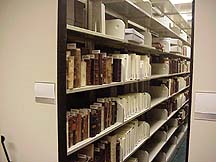
The Digital Quaker Collection represents a portion of the holdings
of the Friends Collection of Lilly Library of Earlham.
Various
individuals contributed to the formation of a bibliography
of books for this collection.
The collection is intended to cover several centuries of Quaker
literature, all considered to be in the public domain. It represents
works written from a variety of perspectives. The collection include
works written by men and women. The geographic range takes in England,
Ireland, and America. One can find in this collection journals,
histories, doctrinal works, letters, sermons, pamphlets, and proceedings.
The Digital Quaker Collection represents a portion of the holdings
of the Friends Collection of Lilly Library of Earlham. 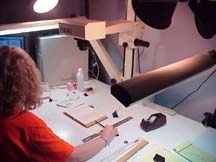 A
Dayton-based company,
A
Dayton-based company, 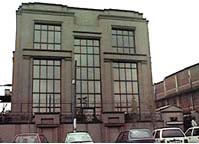 TechBooks has two data conversion facilities in India. The founder
of TechBooks is an American of Indian descent, who was familiar
with the field of technology in India and formed the New Delhi branch
facilities.
TechBooks has two data conversion facilities in India. The founder
of TechBooks is an American of Indian descent, who was familiar
with the field of technology in India and formed the New Delhi branch
facilities.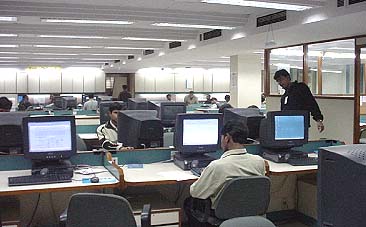 The typical procedure for digitizing old collections
is not to use an optical character recognition (OCR) process, but
to use a data entry technique such as double-key. TechBooks has
proprietary software for data entry which guarantees a near perfect
rate of accuracy. The second time the data is entered, any difference
is signaled and the key operator must reconcile the difference between
the two.
The typical procedure for digitizing old collections
is not to use an optical character recognition (OCR) process, but
to use a data entry technique such as double-key. TechBooks has
proprietary software for data entry which guarantees a near perfect
rate of accuracy. The second time the data is entered, any difference
is signaled and the key operator must reconcile the difference between
the two.